
Storm weeks and spring roofing season do not expose a problem with craftsmanship. They expose the limits of email-based follow-up. A roofing company website Northern Virginia operators need must accept a surge of requests without turning the office into a sorting machine.
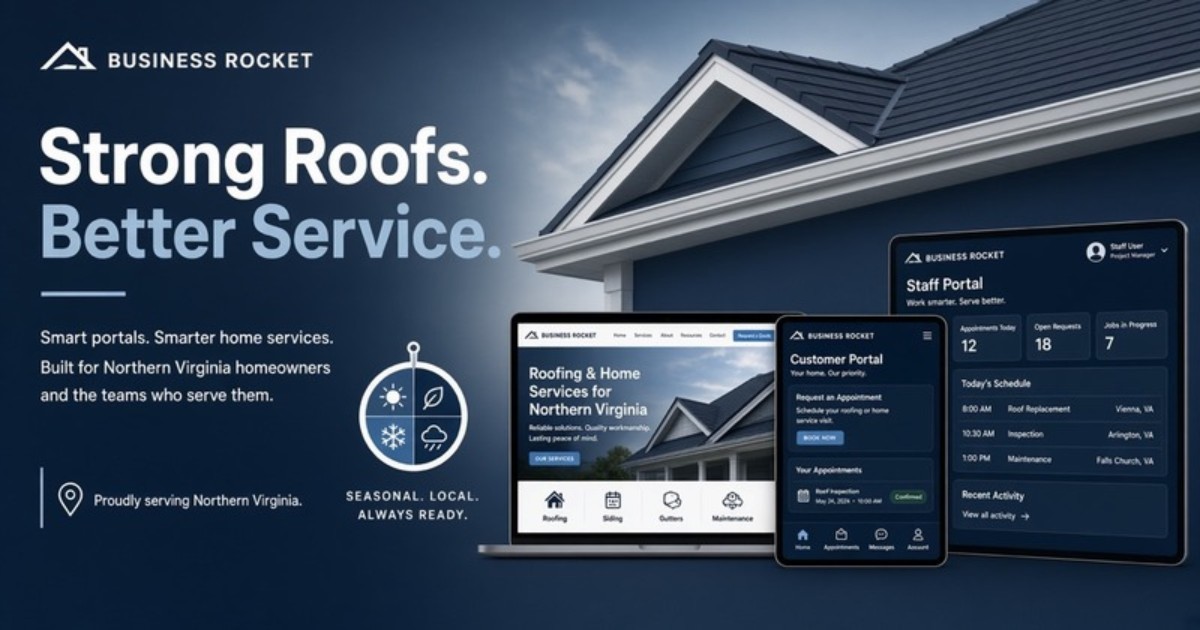
The useful model has three surfaces: a public website for trust and intake, a customer portal for estimates and updates, and a staff portal for ownership and handoffs. Business Rocket delivers those surfaces together so demand does not disappear between a form and a crew.
Busy season multiplies every weak handoff
A brochure site can keep collecting forms while the office falls behind. One inbox receives storm questions, repair requests, replacement inquiries, supplier messages, and estimate replies. Staff members forward emails to each other, then maintain separate notes about who called whom.
When volume rises, the problem is not only response speed. It is knowing which response is due. A homeowner may have sent photos but not received an acknowledgment. Another may be reviewing a replacement estimate. A third may need a schedule update after weather moved production. Those are different stages, even if every message says “roof.”
The office should not have to rebuild the pipeline from memory each morning. Visible ownership and status let the team absorb a spike without lowering every request into the same inbox queue.
Public site: earn trust with clarity, not fabricated proof
The public website should explain services, service areas, the request process, and what information helps the team respond. Repair, inspection, replacement, siding, gutters, and related home-service work may need distinct paths. Clear pages help customers choose the right starting point.
Trust does not require invented testimonials, rankings, project counts, or “#1” claims. Those shortcuts create risk and say little about the operating experience. A clear scope, honest next steps, accessible contact information, and consistent follow-through are stronger signals.
Local coverage should also be accurate. Business Rocket supports companies working across Loudoun, Fairfax, and Prince William. A roofing operator can explain real service boundaries without publishing a made-up office address or stuffing every city name into identical copy.
Intake should separate urgent damage from planned work
Not every lead needs the same response. Active water entry after a storm, a missing-shingle concern, an insurance-related inspection request, and a planned replacement have different urgency and information needs. The website should capture enough context to route the request while keeping the form practical on a phone.
Good intake can ask for the service type, preferred contact method, property area, and a concise description. It should then set an honest expectation for what happens next. That reduces duplicate calls and gives staff a cleaner starting record.
The request should enter the staff workflow directly. If the office still copies every submission from an email into a spreadsheet, the site has created another task rather than reducing one.
Customer portal: keep estimates and next steps together
Roofing work is rarely a single interaction. The customer may review options, ask about scope, approve an estimate, wait for materials, and receive schedule communication that depends on weather. A customer portal keeps the current documents and next steps in one branded place.
That matters when estimate versions change. Email attachments can be downloaded, renamed, and confused. A portal can present the current customer-facing record so both sides start the next conversation from the same version.
Visibility also reduces routine status calls. Customers still need a direct person for judgment, changes, or urgent concerns. The portal handles the repeatable information so staff time stays available for those higher-value conversations.
Staff portal: protect handoffs when crews are full
During a production surge, office-to-field coordination can become a chain of side conversations. A staff portal gives intake, ownership, notes, and status a common home. The person answering the phone can see the current state instead of guessing or interrupting a crew lead.
Weather creates frequent schedule changes in roofing. A visible record helps staff identify which customers need updates and which jobs have dependencies. It does not eliminate judgment or field communication. It prevents those decisions from vanishing into one employee’s phone.
The same view supports follow-up after inspection or completion. If an estimate, customer decision, or final office step remains open, it can stay visible until someone owns it.
Build capacity before the next demand spike
A portal rollout is easier to shape during a normal week than during a storm response. Start by mapping the path from request to assignment, customer update, estimate, production handoff, and closeout. Identify where the team copies information or depends on a verbal update.
Then define the minimum status language everyone understands. Too many statuses create administrative work. Too few leave the office unable to distinguish “new request” from “waiting on customer” or “ready for scheduling.” The system should make the day clearer, not add a reporting project.
Staff adoption also depends on ownership. Decide who reviews new intake, who updates customer-facing information, and how field changes return to the office record. The technology supports the process; it cannot replace an undefined process.
Business Rocket versus a full field-service platform
A full FSM platform may be the right buy when deep inventory, route optimization, payroll, or extensive technician controls are the main requirement. Business Rocket occupies a more focused lane: the branded public website, customer portal, and staff portal that connect intake and follow-up.
The core build is $2,500, with $99/mo hosting and care after launch. Lite brand onboarding is included. An optional $399/mo growth add-on is available after the system is live.
The three-surface product can coexist with a specialized tool your company already uses. The decision is not “all software or no software.” It is choosing a clear owner for the branded front door and portal layer.
Local fit for roofing and home-service operators
Loudoun routes may combine established neighborhoods, newer construction, and wide travel between appointments. Fairfax coverage can create dense inquiry volume. Prince William work can add another production corridor. The system should reflect the operator’s actual territory and crew model.
For Leesburg-focused marketing, local content should answer practical service questions and lead into the same operational intake as every other page. A local page should not create a separate inbox or a copied workflow.
Prepare the front door and the work behind it
Review Business Rocket pricing or talk with us about the way your busy season moves. Call (571) 600-2835 or email help@businessrocket.ai. We will start with the current intake and handoffs, then map the three surfaces around them.
About Business Rocket Editorial
NoVA trade systems · Business Rocket
Practical guides on 3-surface web systems: public booking, client portal, and staff dispatch, for HVAC, plumbing, roofing, and home-service operators across Loudoun, Fairfax, and Prince William.
More from Business Rocket EditorialReady to upgrade from a static brochure to a 3-surface system?
We'll show you public site + client portal + staff portal configured for your service business.
Book a Demo →