
Plumbing companies rarely lose a job because the phone number is impossible to find. They lose control when an emergency call, a remodel estimate, a warranty revisit, and a parts update all live in different text threads with no shared history.
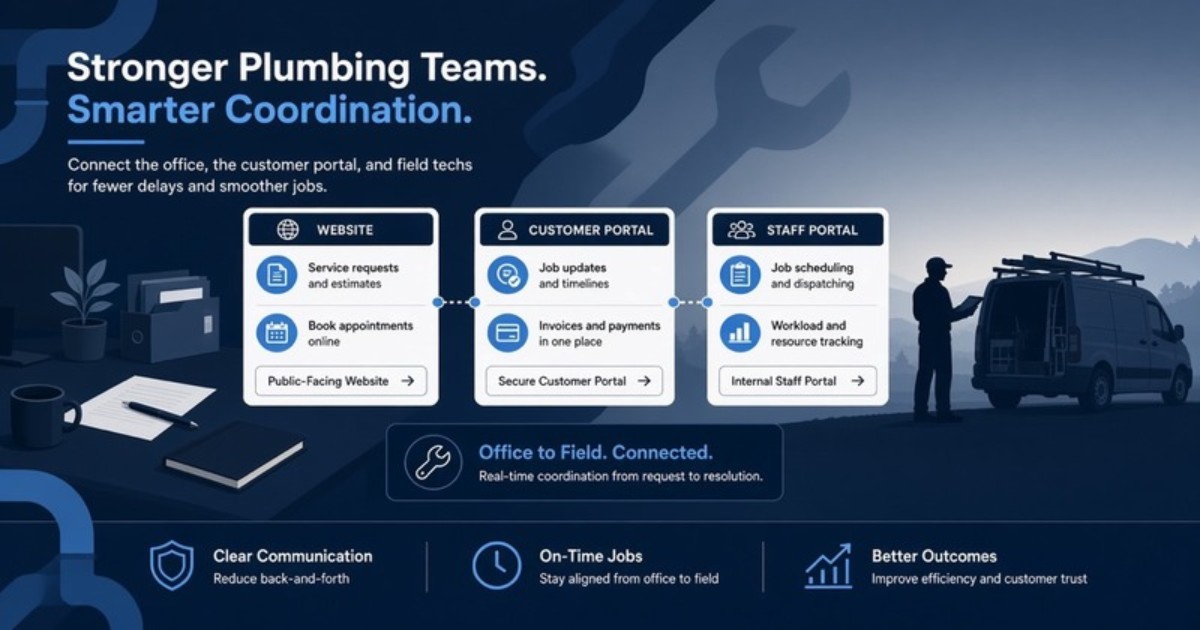
A plumbing company website portal setup connects the public site, customer portal, and staff/dispatch portal. That structure gives the office a better operating system than SMS while keeping the customer experience under the company’s own brand.
The text-thread operating system fails as the shop grows
Owner-on-the-phone can work when one person knows every customer and every open job. Add an office coordinator, several technicians, and a supplier delay, and the same setup starts producing questions nobody can answer quickly. “Who promised Tuesday?” becomes a search across phones.
Texting is useful for a quick alert. It is weak as a permanent job record. A message can omit the address, refer to an outdated estimate, or reach only one employee. Photos and notes get separated from the decision they support. The customer does not see the internal thread, so the office still has to translate every status change.
Spreadsheets add rows and columns but do not solve ownership. They are often updated after the call, if someone remembers. They do not give the customer a place to review a current estimate or see the next step. Growth then creates more administrative work instead of a clearer process.
Start with intake that reflects plumbing work
The public website should do more than collect a name and phone number. Emergency service, a planned fixture replacement, a sewer concern, and a remodel request require different information and response expectations. Good intake routes the request without forcing the customer through a long questionnaire.
Service pages should explain what the shop handles, where it works, and what happens after a request. For Northern Virginia companies, coverage may cross Loudoun, Fairfax, and Prince William. Clear service-area language helps avoid wasted callbacks while giving local customers a direct path into the process.
The website remains the branded front door. The important change is that submissions should feed the same staff view used to assign and follow the work. Copying every form email into another system is not a durable workflow.
Staff and dispatch portal: one place for the day’s work
A staff portal gives the office a shared view of requests, assignments, and status. The dispatcher can see what is waiting, what has an owner, and what needs customer follow-up. Technicians do not have to reconstruct the plan from a series of messages sent at different times.
Plumbing schedules change for legitimate reasons. A hidden leak expands the scope. A shutoff problem takes longer than expected. A needed part is not on the truck. The staff portal should capture the current state so the next person who speaks with the customer has the right context.
This is not about removing judgment from dispatch. It is about giving the dispatcher reliable information. When a same-day request arrives, the office can make a decision based on visible work instead of calling every technician for an update.
Customer portal: reduce status calls without going silent
Customers call when they have no other way to know what is happening. A branded portal can keep estimates, approvals, relevant history, and next steps available without making the homeowner search an inbox. It also gives the office one place to direct routine questions.
The portal should not pretend every plumbing job follows a perfect timeline. It can show the current status and prompt a direct conversation when a decision is needed. That balance reduces phone tag while preserving personal service for urgent or complicated work.
For repeat customers, accessible history supports continuity. The customer can recognize prior work, and the office can prepare for the conversation without relying on one employee’s memory. The result feels organized because the information is organized.
Keep website trust connected to operational follow-through
A professional public site creates an expectation. If the form confirmation is clear but the estimate disappears into email, the customer experiences a gap between marketing and operations. The three-surface model closes that gap by carrying the same brand and process from request through follow-up.
The public site should offer service detail and clear calls to action. The customer portal should show customer-facing information. The staff portal should support internal ownership and handoffs. Trying to make one surface serve all three audiences usually creates confusion.
Business Rocket configures those surfaces as one product. It does not claim to replace every accounting, inventory, or route-planning tool. A shop can keep specialized software that works while removing the disconnected website-and-text layer around it.
A practical Monday-morning plumbing flow
Consider the mix an office may face at opening: an overnight water-heater request, a scheduled remodel walkthrough, a technician asking about a warranty revisit, and a customer waiting on an estimate revision. The public site captures new details. The staff portal shows ownership and status. The customer portal holds the current customer-facing record.
The office still prioritizes the work, calls when urgency demands it, and adjusts the schedule. The difference is that the decisions are recorded in a place the team can use. A late-arriving staff member does not need a verbal briefing on every active thread.
That shared visibility also improves closeout. When the field step is complete, the office knows what follow-up remains instead of discovering it after the customer calls.
NoVA fit without fake local claims
Business Rocket serves trade operators across Loudoun, Fairfax, and Prince William. We do not create fictional customers, rankings, reviews, or addresses to make a local page sound specific. Local relevance should come from understanding the service pattern and linking customers to the right information.
Fairfax County routes can combine dense schedules with unpredictable traffic and varied housing stock. Centreville may be one part of a wider service area rather than a separate operating model. The portal layer helps the office manage that real coverage without pretending city names are a strategy.
- Plumbing websites and portals
- Fairfax County hub
- Centreville location page (primary local link for this article)
What is included and the next step
The Business Rocket core build is $2,500 and includes the public website, customer portal, staff/dispatch portal, and lite brand onboarding. Hosting and care are $99/mo. An optional $399/mo growth add-on is available after launch.
Request a workflow review, call (571) 600-2835, or email help@businessrocket.ai. Bring the actual path your jobs follow today, including the group texts and spreadsheets. That is where the useful portal plan starts.
About Business Rocket Editorial
NoVA trade systems · Business Rocket
Practical guides on 3-surface web systems: public booking, client portal, and staff dispatch, for HVAC, plumbing, roofing, and home-service operators across Loudoun, Fairfax, and Prince William.
More from Business Rocket EditorialReady to upgrade from a static brochure to a 3-surface system?
We'll show you public site + client portal + staff portal configured for your service business.
Book a Demo →