
Ashburn homeowners often research an HVAC company before a truck turns onto their street. They compare service detail, the clarity of the next step, and the way the company communicates. Strong installation work can still be undercut by a site that feels unfinished or follow-up that feels improvised.
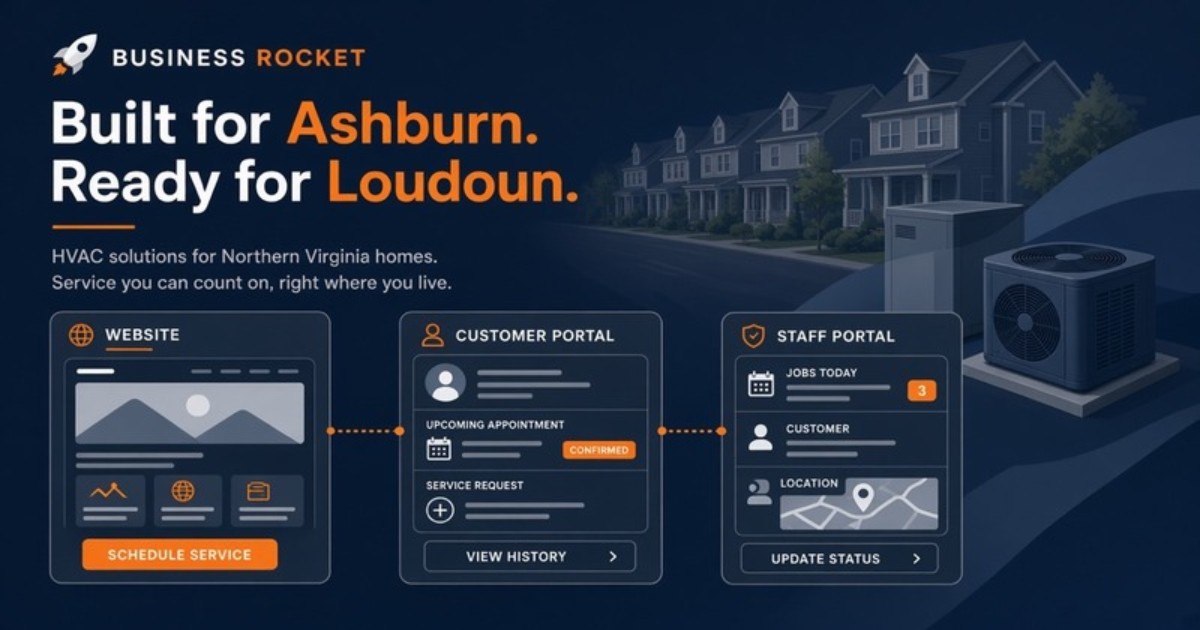
An HVAC website Ashburn operators can use is not simply a louder logo. It connects a public website, customer portal, and staff portal so the same professional experience continues from research through estimate and service history.
Ashburn HVAC buyers are evaluating the process early
Heating and cooling purchases can involve urgency, a large replacement decision, or an ongoing maintenance relationship. A homeowner wants to understand what the company handles, where it works, and what will happen after a request. Vague service pages push those questions into the first phone call.
The public site should separate emergency or repair needs from planned replacement and maintenance inquiries. It should make the contact path clear on a phone and set a realistic expectation for follow-up. That first handoff is part of the service experience.
Local relevance comes from useful information, not claims about being the best in town. Business Rocket does not invent Ashburn customers, reviews, rankings, project counts, or addresses. The site should sound credible because it explains the real process.
Replacement leads need a better path than one contact form
A system-replacement inquiry often develops over several conversations. The homeowner may share equipment details, review options, ask about scope, and revisit the estimate. When every exchange lives in email, the current version becomes harder to identify.
The website can begin with practical intake that distinguishes replacement planning from a no-heat or no-cooling call. The customer portal can then keep the customer-facing estimate and next steps accessible. Staff can see where the decision stands without asking the owner to search an inbox.
This does not turn the website into an automated salesperson. It gives the human sales process a stable record. The operator can still explain tradeoffs and answer property-specific questions while reducing attachment confusion and duplicate outreach.
Maintenance relationships benefit from visible continuity
Maintenance work is different from a one-time emergency. The customer may return over several seasons, and the company needs to recognize the relationship. A customer portal can provide relevant history and a consistent route back into service.
That continuity also supports the office. Staff do not have to rely on one employee remembering the prior conversation. They can start with shared context, then use judgment for the current need.
The public website should explain the maintenance approach without promising unsupported results. The portal carries the relationship after the marketing page has done its job.
What breaks in template and brochure setups
Template sites usually end at notification email. They may look modern, but the office still copies the request into a spreadsheet, forwards details to a technician, and tells the customer to watch for another message. Each step creates another source of truth.
Group texts then become dispatch. One person changes the plan, another misses the message, and the customer receives an update based on an older schedule. The failure is operational, not visual.
Buying another redesign does not repair that path. The system needs clear surfaces for the public, the customer, and the staff.
Three surfaces in practice for an Ashburn HVAC shop
The public website presents HVAC services, local coverage, and useful intake. The customer portal holds estimates, customer-facing status, and relevant history. The staff portal gives the office visibility into ownership, follow-up, and dispatch handoffs.
A request can start on an Ashburn service page and enter the staff view without manual copying. The office assigns the next step. The homeowner sees current information in the branded customer portal. Each audience gets the information it needs without sharing an internal workspace.
Business Rocket configures these surfaces as one product. A shop can continue using specialized accounting, inventory, or field software where needed. The portal layer is not presented as advanced route optimization or a full enterprise FSM replacement.
Design the staff view around Loudoun route decisions
Dispatch is not only a calendar. The office is balancing urgency, technician fit, existing commitments, and travel across the service area. The staff portal should make the current work visible enough for a dispatcher to make those choices.
Simple, shared statuses usually beat a complicated workflow nobody updates. New request, awaiting review, waiting on customer, scheduled, and follow-up needed may be useful starting concepts, but the final structure should match the company’s language.
The key is ownership. Every open item should have a clear next action or person responsible. That reduces the number of jobs that remain “somewhere in the group chat.”
Use local pages without creating duplicate operations
An Ashburn page and a broader Loudoun page can answer different visitor questions, but both should feed the same intake and staff process. Local marketing should not create separate inboxes or disconnected follow-up rules.
Business Rocket serves trade companies across Loudoun, Fairfax, and Prince William. For an Ashburn-focused HVAC operator, the site can emphasize the relevant service mix while keeping a scalable countywide operating structure behind it.
Price the system, not another isolated redesign
The Business Rocket core build is $2,500 and includes the public website, customer portal, staff portal, and lite brand onboarding. Hosting and care are $99/mo. Optional growth support is $399/mo after launch.
The growth add-on can support ongoing market work, but the three-surface system stands on its own. The first priority is making intake, customer visibility, and staff follow-up coherent.
Map your current Ashburn HVAC workflow
Book a workflow demo if your crews already outrun the systems behind them. Call (571) 600-2835 or email help@businessrocket.ai. Bring one recent repair, replacement, or maintenance request, and we can trace where the handoffs need a better home.
About Business Rocket Editorial
NoVA trade systems · Business Rocket
Practical guides on 3-surface web systems: public booking, client portal, and staff dispatch, for HVAC, plumbing, roofing, and home-service operators across Loudoun, Fairfax, and Prince William.
More from Business Rocket EditorialReady to upgrade from a static brochure to a 3-surface system?
We'll show you public site + client portal + staff portal configured for your service business.
Book a Demo →